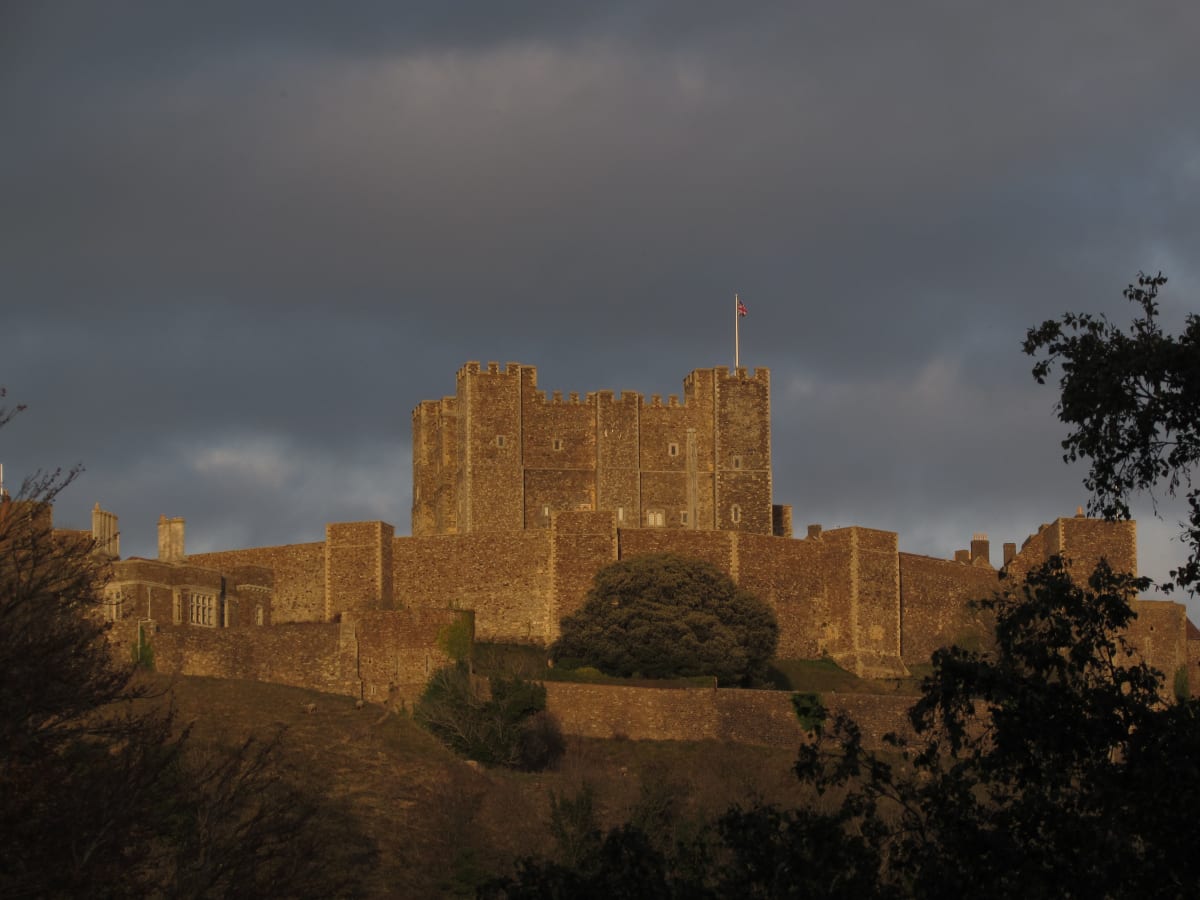
Dover Castle Throughout the Medieval and Early Modern Periods
Brief History and Construction
Located on the Southeast coast of England in Kent, Dover Castle stands proud over the white cliffs, which have naturally defended the site against invaders for centuries.1 Referred to as ‘The Key to England’ or ‘Clavis Angilae’ by Matthew Paris, the structure has been subject to great change over the ages.2 The site’s history dates back to the Iron Age, with archaeologists discovering evidence for an Iron Age Hillfort surrounding the Anglo-Saxon Church.3 This Grade I listed monument also includes one surviving Roman lighthouse, dating to around the first century AD, and a series of tunnels beneath the main castle, dating to the thirteenth and twentieth centuries.4
In 1066, William the Conqueror captured the port, establishing a fortification now archaeologically invisible to visitors. It was not until the 1180s that the castle itself underwent construction under the orders of Henry II, led by his engineer Maurice, who constructed the inner bailey, part of the outer bailey and, most importantly, the Great Tower.5 Further changes and additions to the site were made by King John between 1199 and 1216, followed by King Henry III, who continued to strengthen the fort into the thirteenth century: it was during this time that the Castle reached its peak, transforming into one of the most sophisticated castles in Europe.6 Under Edward IV, the great tower once again became a site of occasional residence.7 During the Tudor period, it was visited occasionally by monarchs and other significant figures; the site was last occupied by royalty in 1625.8 It served no other significant purpose during the Early Modern period than to hold French and Spanish prisoners during the Nine Years War (1688-97) and the War of Spanish Succession (1701-14).9 Scattered across the inner walls of the Great Keep, the marks of these prisoners are still visible today. The castle was subject to no other great modifications and improvements until the arrival of the French Revolutionary and Napoleonic Wars.10 The significance of this site cannot be understated; over the centuries, its strong walls have withstood multiple sieges and both World Wars, and have housed countless significant individuals. It truly is a remarkable structure with a fascinating past.
Key Features of the Castle
The Great Keep
The original Norman motte and bailey structure was replaced by an impressive stone keep under Henry II during the twelfth century.11 The structure and conventional rectangular plan of the Great Keep was perfectly fit for residence, as it provided much more useable space.12 Its interior had high levels of domestic comfort, multiple rooms, and even a piped water supply.13 The construction of the Great Keep required great expenditure: pipe rolls indicate that Henry II spent more than £6,000 on the keep between 1179 and 1188, making its overall cost much higher than that of similar contemporary structures.14 Between 1205 and 1214, King John made improvements to the domestic structures within the inner bailey, and in 1240, an improved hall and monarch’s chamber was constructed, which was then refined and modernized particularly during the Tudor period.15 Within the keep also lies the chapel. Dedicated to Thomas Becket, the chapel is highly decorated and Romanesque in its design.16
The Curtain Walls
Under Henry II, defensive structures surrounding the keep were also constructed. The inner curtain wall, and a portion of the outer certain wall, consisted of mural flanking towers, which were rectangular in shape: these indicate the military functions of the site, as such structures allowed easy defence by cross-fire during conflicts, and also allowed sections of the curtain wall to be isolated if they were captured by the enemy.17 Along the inner curtain, there were 14 such towers, and entrances to the north and south of the structure were protected by barbicans.18 The outer curtain wall was completed and modified by King John: he made additions to the northern side of the outer curtain, where the towers are ‘D’ shaped rather than rectangular.19
The Siege of Dover and the modifications that followed.
In 1216, Louis of France arrived in England. When he rode to Dover, he was met with an intimidating sight: Henry II’s stone keep stood at 83ft high, and its walls were up to 20ft thick.20 Circled by high curtain walls, with its gatehouse protected by wooden barbicans, Dover Castle appeared impenetrable.21 The sieges are mentioned briefly by contemporary and near-contemporary Latin Chroniclers, such as Matthew Paris.22 Within the walls of the castle, Hubert de Burgh had prepared around 140 knights.23 The structure, however, was so well defended, supplied, and strategically placed that Louis failed to capture the stronghold: this loss arguably marked the failure of his campaign to take power.24 Had he been able to call in reinforcements overseas, the sieges may have been a success, but Dover’s commandment over the channel prevented him from doing so: a fleet, assembled by Hubert de Burgh, intercepted his calls for aid.25
Dover’s survival enabled the succession of King Henry III, and also led to modifications and improvements to the castle’s defences.26 During the sieges, Dover had not escaped unscathed: John had previously called for the construction of a gate at the northern end of the curtain wall, but it was poorly placed, with nearby high ground enabling Louis to launch an attack.27 They mined underneath the gate, causing the eastern tower to collpase.28 Under Hubert de Burgh, defences held, and following Henry III’s accession to the throne, Louis withdrew in 1217.29 Once the war had ended, Henry III ordered for the northern gate to be blocked and replaced by two others on the western and eastern sides of the site: Constable’s Gate, and the Fitzwilliam Gate.30 Furthermore, the medieval tunnels beneath the site were created as a direct response to the siege.31 The primary function of these tunnels was to allow a stronger line of communication for those defending the structure’s northern perimeter, however they also could enable defenders to secretly muster up a counter-attack.32 The castle was besieged once more in 1265 with Eleanor de Montfort in residence, but it was short lived and brought to a halt through negotiations.33
Later Changes - The Early Modern Period
Under the Tudors, Dover maintained its military importance. During the reign of Henry VIII (1509-1547), the construction of artillery forts across the South-East coast was underway following his break from Rome: three artillery fortifications were constructed at Dover to protect the new harbour.34 These structures formed a chain of defence across the coast, and some of the most impressive surviving examples include Deal and Walmer Castle.35
Under Henry VIII, Dover also maintained its residential function. Charles V, The Holy Roman Emperor, met Henry VIII at Dover in 1522, marking the start of a lengthy diplomatic visit.36 Furthermore, improvements were made to the apartments within the Great Keep in 1539 to accommodate Anne of Cleves on her way to marry the king.37 Elizabeth I (r.1557-1603) also visited the castle in 1573, and she made efforts to ensure the castle was maintained throughout the war with Spain and during the last decades of her reign.38 During the seventeenth century, its importance as a space of royal residence began to diminish. It’s military legacy lived on, and it played a key role during the Napoleonic Wars, a period in which it was subject to further modifications.39 Dover Castle lived on to withstand both World Wars; only in 1958 did the last army detachments leave the site.40
Historic Graffiti
The Great Keep is scattered with historic graffiti, etched into the walls mainly by prisoners of war kept within the structure during the War of Spanish Succession (1701-14).41 Often, the word graffiti bears negative connotations. The thought of graffiti at a historic site is a shocking thought, but it certainly isn’t new. Historic graffiti is an insightful source into the lives and experiences of everyday individuals throughout history. Every time I visit Dover Castle, I find more and more beautiful examples of such graffiti hiding within the Great Keep, including names, initials, religious imagery and crucifixion scenes, and even a ship! It makes you wonder - who were these people? What did these marks mean to them? Were they leaving a message, or was it simply to pass the time?
Bibliography
Brabbs, Derry, England’s Heritage, (London: Cassell & Co, 2001)
Burton, Neil, English Heritage from the Air, (London: Sidgwick & Jackson, 1989)
Coad, Jonathan, Dover Castle, (London: English Heritage, 2007)
Davis, Philip, ‘Dover Castle’, Gatehouse, https://gatehouse-gazetteer.info/English%20sites/1612.html, [Accessed 11 November 2025]
Hanley, Catherine. “The Siege of Dover: THE KEY TO ENGLAND.” Medieval Warfare Vol.7, no. 2 (2017)
Historic England, Military Sites Post-1500: Scheduling Selection Guide. (Swindon: Historic England, 2018)
Pattison, Paul, ‘History of Dover Castle’, English Heritage, https://www.english-heritage.org.uk/visit/places/dover-castle/history-and-stories/history-dover/ [Accessed 5 November 2025]
‘The Sieges of Dover Castle 1216-17’, English Heritage, https://www.english-heritage.org.uk/visit/places/dover-castle/history-and-stories/the-sieges-of-dover/ [Accessed 24 November 2025]
References
Brabbs, p.122. ↩︎
Hanley, p.16. ↩︎
Coad, p.39. ↩︎
Davis. ↩︎
Pattison. ↩︎
Ibid. ↩︎
Ibid. ↩︎
Ibid. ↩︎
Ibid. ↩︎
Ibid. ↩︎
Brabbs, p.122. ↩︎
Burton, p.116. ↩︎
Ibid. ↩︎
Brabbs, p.122, and Davis. ↩︎
Davis, and Brabbs, p.122. ↩︎
Brabbs, p.124. ↩︎
Davis ↩︎
Ibid. ↩︎
Ibid. ↩︎
Hanley, p.16. ↩︎
Ibid. ↩︎
Ibid. ↩︎
Ibid. ↩︎
Ibid., p.22. ↩︎
Ibid., and ‘The Sieges of Dover Castle 1216-17’, English Heritage. ↩︎
Hanley, p.22. ↩︎
Davis. ↩︎
Ibid. ↩︎
Ibid. ↩︎
Pattison. ↩︎
Brabbs, p.124. ↩︎
Ibid. ↩︎
Pattison. ↩︎
Pattison and Davis. ↩︎
Historic England, Military Sites Post-1500: Scheduling Selection Guide., p.4. ↩︎
Pattison. ↩︎
Ibid. ↩︎
Ibid. ↩︎
Ibid. ↩︎
Burton, p.131 ↩︎
Pattison ↩︎